Showing posts with label world war ii. Show all posts

Saturday, October 6, 2012

An escaped German P.O.W. ... finding a new life in America

Relatively few of the hundreds of thousands of German prisoners of war held in the U.S. during World War II escaped from their prison camps. Most of them were easily captured when they couldn’t blend into American society very well. By the end of the war, when those prisoners were sent back to Germany, only 12 remained at large. And by the 1960s, all but one – a man named Georg Gaertner – hadn’t been accounted for.

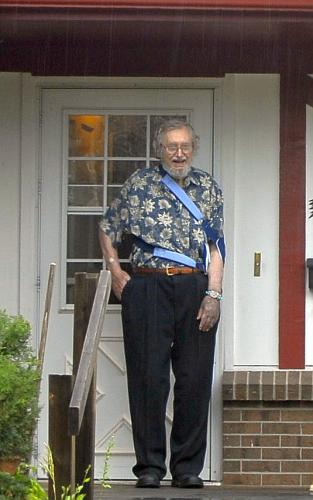
Georg Gaertner, also known
as Dennis Whiles, in 2009

As the war neared its end, Gaertner learned that his home town in Germany had been taken by the Russian army. Russian revenge against the German population in such towns was brutal, and most are now part of Poland. To avoid being sent back there and face Russian wrath, Gaertner decided to try to remain in America. On September 21, 1945, he escaped from a prison camp in New Mexico and hopped onto a freight train that took him to California.

Gaertner could speak English and had served as a prison translator, and that skill would serve him well. He took a series of odd jobs, working as a dishwasher and farm laborer and keeping a low profile as he moved from town to town to avoid attention. As he improved his English-language skills, he also learned how to fit into American life. He carried a Social Security card under the name of Dennis Whiles, married an American woman with two kids in the 1960s, and took on higher-paying jobs in construction and sales, and even as a ski instructor and tennis instructor. In the early 1980s, Gaertner’s wife – whom knew nothing of his past – became suspicious when he refused good job opportunities that would have required background checks. When she threatened to leave him, he told her the truth and decided to come clean.

Gaertner knew that he had been mentioned in a book titled Nazi Prisoners of War in America, so in November 1983 he called the author – Texas A&M University professor Arnold Krammer.

"The caller identified himself as Dennis Whiles and commented that he had enjoyed reading my book," Krammer was quoted in a 1985 Houston Chronicle article. "He also said that it was very accurate, admitting that he had once been a German prisoner of war." The men spoke for a long time, and eventually Gaertner told Krammer who he really is.
 
Krammer and Gaertner collaborated to write another book, titled Hitler's Last Soldier in America, published in 1985. Gaertner reportedly obtained U.S. citizenship in 1989 and lives today in Colorado.
 

Saturday, September 1, 2012

Roosevelt ... the target of a hapless U.S. Navy ship


Security might have been tight when U.S. President Franklin Roosevelt traveled secretly across the Atlantic on an American battleship as the first part of a journey to meet with Britain’s Winston Churchill and Russia’s Joseph Stalin in Tehran, Iran for a discussion of the war in late 1943 – but that mattered little when another American warship providing “protection” sent a live torpedo toward the ship carrying Roosevelt.
The story, relayed through a few newspaper accounts and a 1994 article by naval historian Kit Bonner in The Retired Officer Magazine, reproduced on the USS Iowa Veteran's Association website, goes something like this: Roosevelt was aboard the USS Iowa, which was accompanied by three smaller warships for the voyage in November 1943. After the convoy passed Bermuda, weather balloons were launched from the Iowa for a demonstration of the big ship’s anti-aircraft guns. Some of the balloons drifted into the area of the destroyer USS William D. Porter, one of the escort ships. The Porter’s captain – Lt. Commander Wilfred Walter – sent his crew to battle stations to join in the anti-aircraft gun show for Roosevelt. Walter also decided, although it’s not clear from published accounts if this was a planned part of the demo or not, to simulate a torpedo attack against the Iowa.
The torpedoes were supposed to be disarmed before firing, but one was not – and it quickly made its way toward the Iowa and Roosevelt, much to the horror of Walter and his officers and crew. After a few frantic attempts to contact the Iowa through signaling, the Porter broke the radio silence that had been in force for the voyage and informed the Iowa of the mistake. The Iowa turned in time to avoid the torpedo, which exploded behind the ship, after hitting its wake.
 
Fearing an assassination attempt on Roosevelt, the Iowa trained its guns on the Porter, but backed down after Walter told of the mistake. But Walter and his entire crew were ordered back to Bermuda with their ship. Ultimately, a crewman was found guilty in a court martial and sentenced to 14 years of hard labor for his mistake and attempt to destroy evidence, but Roosevelt overrode that punishment. Walter and at least some of his officers reportedly found themselves in dead-end Navy positions after the incident, too.

Unfortunately, the Porter seemed to be jinxed, finding itself on the wrong end of this and other mishaps throughout the war, as Bonner noted in the article referenced above. The ship met its end in an unusual way, too, in June 1945. A Japanese kamikaze, or suicide, plane carrying a large bomb failed to hit the Porter, but crashed alongside, without its payload exploding on impact. The plane slowly sunk under the water, where its huge bomb finally exploded, ripping apart the Porter’s hull under its waterline. The ship sank within hours.


Saturday, July 28, 2012

Uh-oh ... Roosevelt didn't ride in the Capone car

Uh-oh. Ever heard the story about President Franklin Roosevelt using former crime boss Al Capone's armored car, which reportedly had been seized by the Internal Revenue Service upon Capone's conviction, to move around Washington when security concerns became a big issue as World War II began? The History Insider noted this supposedly well-documented item in a December 2011 entry, but new research suggests that the story is only that -- a story. In other words, it's bogus. False. Myth.

The car in question -- a 1928 Cadillac town car -- is being sold this weekend through RM Auctions. And research noted by RM suggests that the U.S. government never possessed the car, and might not have known that it existed. Instead, it appears that one of Capone's associates sold it in 1932 to a couple who worked for a traveling carnival. Their plan to make money by showing the car to through the carnival never paid off, and they sold it about a year later to someone else, who took it to England, where it was displayed. The car was sold and resold privately several times, and ended up back in the U.S.by the mid-1960s, where it's been since.

Think you might want to bid on it this weekend? That'll set you back an estimated $300,000 to $500,000, according to the auction house's announcement.

Sunday, December 11, 2011

Franklin Roosevelt and Al Capone's car ...

On December 8, 1941 – one day after the Japanese surprise attack on American forces at Pearl Harbor -- U.S. President Franklin Roosevelt was set to make one of the most important speeches of his political career.  He was to address Congress (and millions of Americans via radio broadcasts) from the House Chamber at the U.S. Capitol, noting the “Day of Infamy” and seeking a declaration of war against Japan.

But before he could do that, there was a problem to overcome. Government regulations had prohibited spending more than $750 for a car, even for the president. So on previous trips around Washington, Roosevelt had used a typical, non-bullet proof car. But on this day, when suspicions ran unusually high so soon after the Pearl Harbor attack, the possibility that Japan might have agents in place to try to kill the president couldn’t be easily dismissed. So riding in a standard, off-the-rack-type of car from the White House to the Capitol seemed to be a tremendous risk for the American leader.

Steven M. Gillen’s 2011 book Pearl Harbor: FDR Leads the Nation Into War offers the resolution to the problem. According the Gillen, it went down like this:
   “'Mr. President, I’ve taken the liberty of getting a new car,’” White House Secret Service head Mike Reilly said to Roosevelt after he stepped out of the White House for the trip to the Capitol. “‘It’s armored, I’m afraid it’s a little uncomfortable, and I know it has a dubious reputation.’
   ‘Dubious reputation?’ FDR asked inquisitively.
   ‘Yes sir. It belonged to Al Capone. The Treasury Department had a little trouble with Al, you know, and they got it from him in the subsequent legal complications. I got it from treasury.’
   Roosevelt seemed amused. ‘I hope Al doesn’t mind,’ he said.”

Al Capone was a notorious gangster who was convicted in 1931. Roosevelt continued using Capone’s car for trips into 1942, when it was replaced by a specially designed armored car that the federal government leased from Ford Motor Co. for $500 annually.
The Capone car has been in private hands for many decades, according to a history of the car provided by RM Auction in 2006. Wonder where it is now ...

(The History Insider note: More recent information suggests that this story is false, despite what would seem to be evidence from a solid source here.)

Saturday, November 5, 2011

Andy Rooney ... on World War II

The late Andy Rooney, the well-known journalist who was a nationally syndicated columnist and popular t.v. commentator, offered an excellent account of his experiences and observations as a young World War II correspondent in his book My War. For example:
  • Observing the French countryside in the Normandy region shortly after the Allied landing in June 1944 -- "Our bombers must have destroyed the towns [Montebourg and Valognes] in an effort to cut the German supply lines to Cherbourg and it was the first time it had occurred to me that the French people of Normandy must have felt some ambivalence about the Invasion. It was true that they were being freed but at the cost of the total destruction of everything they had. And there's no question that many of the people of Normandy were sullen in their attitude toward Americans."
  • Noting that correspondents were given guns to protect themselves from German snipers thought to be left behind as Allied forces moved into Germany:  "This made those correspondents liable to execution as spies if they'd been captured, and after a few days in Germany, during which time there was not a single incident of sniper fire from village windows, reporters turned in their guns. That's what was strange. There was no danger at all to an American in a German town once our troops had gone through it."

Monday, October 24, 2011

Stalin's fear of wristwatches ...

As World War II ended, each of the major victorious powers -- the United States, the Soviet Union, and Britain -- pushed hard for its share of the spoils of war and to determine its place in a new world order. Many decisions were made at the Potsdam Conference in Germany in the summer of 1945. Participants were U.S. President Harry S. Truman, who had recently entered the presidency following the death of Franklin Roosevelt in May; Soviet Union Communist Party General Secretary Joseph Stalin; British wartime Prime Minister Winston Churchill; and then Churchill's successor, new Prime Minister Clement Attlee, who stepped into the role after Churchill's party lost its leadership role following British elections.

Generally, the U.S. and Britain feared Soviet expansionism and worked to control Stalin's efforts to install communism where it hadn't existed prior to the war. But Stalin feared something else, as noted in Charles L. Mee Jr.'s book Meeting at Potsdam (Pax Americana Series), originally published in 1975. "(Stalin) perceived a new and vital danger:  millions of Russian soldiers had seen foreign lands, foreign wealth, foreign freedom. Thousands and thousands had traded everything they had with British and American soldieres for -- wristwatches. Wristwatches, gold plated, silver plated, with seventeen-jewel movements: what unimaginable wealth they represented, and every single British and American soldier seemed to have one, and treat it casually, as though it were a mere convenience." As a result, Stalin "did indeed fear that the Russian people would be infected by contact with the West, its wristwatches and its ideas."