Saturday, October 6, 2012

An escaped German P.O.W. ... finding a new life in America

Relatively few of the hundreds of thousands of German prisoners of war held in the U.S. during World War II escaped from their prison camps. Most of them were easily captured when they couldn’t blend into American society very well. By the end of the war, when those prisoners were sent back to Germany, only 12 remained at large. And by the 1960s, all but one – a man named Georg Gaertner – hadn’t been accounted for.

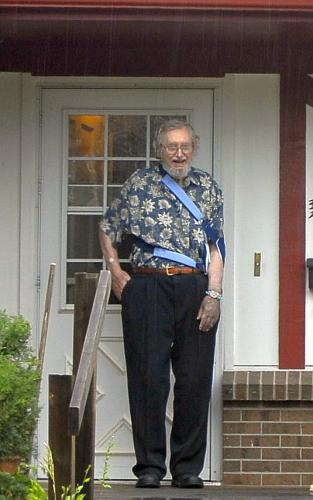
Georg Gaertner, also known
as Dennis Whiles, in 2009

As the war neared its end, Gaertner learned that his home town in Germany had been taken by the Russian army. Russian revenge against the German population in such towns was brutal, and most are now part of Poland. To avoid being sent back there and face Russian wrath, Gaertner decided to try to remain in America. On September 21, 1945, he escaped from a prison camp in New Mexico and hopped onto a freight train that took him to California.

Gaertner could speak English and had served as a prison translator, and that skill would serve him well. He took a series of odd jobs, working as a dishwasher and farm laborer and keeping a low profile as he moved from town to town to avoid attention. As he improved his English-language skills, he also learned how to fit into American life. He carried a Social Security card under the name of Dennis Whiles, married an American woman with two kids in the 1960s, and took on higher-paying jobs in construction and sales, and even as a ski instructor and tennis instructor. In the early 1980s, Gaertner’s wife – whom knew nothing of his past – became suspicious when he refused good job opportunities that would have required background checks. When she threatened to leave him, he told her the truth and decided to come clean.

Gaertner knew that he had been mentioned in a book titled Nazi Prisoners of War in America, so in November 1983 he called the author – Texas A&M University professor Arnold Krammer.

"The caller identified himself as Dennis Whiles and commented that he had enjoyed reading my book," Krammer was quoted in a 1985 Houston Chronicle article. "He also said that it was very accurate, admitting that he had once been a German prisoner of war." The men spoke for a long time, and eventually Gaertner told Krammer who he really is.
 
Krammer and Gaertner collaborated to write another book, titled Hitler's Last Soldier in America, published in 1985. Gaertner reportedly obtained U.S. citizenship in 1989 and lives today in Colorado.
 

Saturday, September 29, 2012

Jefferson ... on the "degeneracy of the human body"

Today’s Americans are continually bombarded with messages urging them to get more exercise, but even centuries ago, America’s Thomas Jefferson thought that the domestication of the horse was to blame for reducing the health of the European-Americans who rode them most often and regularly.  He questioned whether the advantages of riding were greatly outweighed, over the long run, by the disadvantages brought through a reduction in the amount of exercise his countrymen enjoyed.

His thoughts were put on paper in an August 19, 1785 letter to his 15-year-old nephew, Joseph Carr. Jefferson wrote: “The Europeans value themselves on having subdued the horse to the uses of man. But I doubt whether we have not lost more than we have gained by the use of this animal. No one has occasioned so much the degeneracy of the human body. An Indian goes on foot nearly as far in a day, for a long journey, as an enfeebled white does on his horse, and he will tire the best horses.”

Several of Jefferson’s letters include his extensive thoughts on the value of exercise – and walking in particular – are provided on the website for Monticello, his home in Virginia.

Saturday, September 22, 2012

Washington's teeth ... not for the squeamish


One of several sets of Washington's false teeth
Despite his efforts to take care of his teeth throughout his life, George Washington had only a single remaining natural tooth by the time he was inaugurated as U.S. president in 1798, according to several of his biographers. By that time, he also had his first set of full dentures, made by dentist John Greenwood, who had previously also supplied him with partial dentures that hooked to his natural teeth. All of these various sets of false teeth were made primarily of a base carved from hippopotamus ivory, into which human or cow teeth were attached. Small screws and springs were also part of these state-of-the-art 18th century dentures.

Washington’s apparently ongoing, painful problems with his teeth and these dental contraptions over many years – issues that thankfully do not confront so many Americans today – are noted in several letters he wrote. For example, at least as early as May 1781 he wrote to another dentist, John Baker, seeking his help: 

“Sir, A day or two ago I requested Col. Harrison to apply to you for a pair of Pincers to fasten the wire of my teeth.  I hope you furnished him with them. I now wish you would send me one of your scrapers as my teeth stand in need of cleaning, and I have little prospect of being in Philadelph. soon.It will come very safe by the Post & in return, the money shall be sent so soon as I know the cost of it. I am Sir Yr Very Hble Serv.  G. Washington”

In another letter, to the dentist Greenwood and dated February 20, 1795, Washington offers his thanks for a new set  (his first complete set?) of false teeth and writes that he is enclosing $60 in payment:

Washington, with dentures seemingly in place,
in portrait by Gilbert Stuart
“Sir, Your last letter, with its accompaniment, came safe to my hands on tuesday last. Enclosed you will receive sixty dollars in Bank notes of the United States. In addition to which, I pray you to accept my thanks for the ready attention which you have at all times, paid to my requests, and that you will believe me to be, with esteem, Sir … Your very Hble Serv. G. Washington”

The $60 cost of those dentures was quite a sum in the late 18th century. In today’s dollars, that amount would be roughly equivalent to $1,090.

Portraits of Washington as an older man are notable for the puffy, slightly distorted appearance of his cheeks and lips, which many historians have attributed to his false teeth. But you have to wonder if … or why … he would have kept them inside his closed mouth, which couldn’t have been comfortable, for the many hours that he stood or sat still for a portrait. Was it that his lips and cheeks would have looked even worse if he not worn his dentures in place of his nonexistent natural teeth?


Saturday, September 15, 2012

President Hoover ... authorizing a break-in

As the Great Depression continued in the early 1930s, U.S. President Herbert Hoover faced growing criticism, and that bothered him greatly – so much that he went to great, and illegal, attempts to stem it, writes Christopher Andrew in his 1996 book For the President's Eyes Only: Secret Intelligence and the American Presidency from Washington to Bush.

It seems that Lawrence Richey, Hoover’s personal assistant who previously worked closely with the Secret Service, ensured that people on the president’s enemies list were kept under surveillance as needed. And possibly as a result of that effort, Hoover received a report indicating that New York Democrats had collected some type of information – its nature unknown – that would damage him politically.

Hoover turned to a former aide, Lewis Lichtenstein Strauss, to find out more. Strauss approached U.S. Navy intelligence officer Glenn Howell, who wrote in his log, according to Andrew’s book: “Strauss told me that the President is anxious to know what the contents of the mysterious documents are, and Strauss is authorized by the President to use the services of any one of our various government secret services.”

When Howell and another man broke into the office in which the damaging information was said to be held, they found it vacant.  So then they identified and followed the former tenant, a Democratic operative named James J. O’Brien.

“We shadowed him for a bit and then came to the conclusion that no President of the United States need be afraid of a ham-and-egger [someone not possessing any particularly striking qualities] like O’Brien,” Howell later wrote. He added that after reporting their findings, they received word to end the operation.
 
The incident remained secret for many years, but became public after Rutgers University history professor Jeffrey M. Dorwart discovered evidence of it in the early 1980s.
 

Saturday, September 8, 2012

The 3 a.m. president ... not whom you might think

Most of us who've worked in large organizations, whether public or private, know that the process for making big decisions can be surprising. No matter how many formal procedures are established, decision-making often comes down to the whims of people on whom the final choice depends. And the White House is no exception.

In his 1997 book Confessions of a White House Ghostwriter: Five Presidents and Other Political Adventures, former presidential speechwriter James C. Humes, who served in the Eisenhower, Nixon, Ford, and Reagan administrations, offered some interesting insight into this phenomenon:

“Sometimes – even if the general details of a legislative message have been hammered out – unagreed matters remain because of fights between competing departments. As the various drafts of the proposed message are relayed to various cabinet heads for approval, one cabinet secretary knocks out one work or item and his rival puts it back in. A change goes in – then it’s taken out.  … The hours pass from late night into the wee hours of the next day, when the president is scheduled to deliver the message. Finally, the department heads to go bed and final decision is left to the (speech)writer – hence the 3 a.m. president," Humes wrote.

“I remember one message on mass transit by President Nixon. The bone of contention was funding” from either the gasoline tax or general revenues, he wrote. “I had to decide. I chose general revenues. Strangely, my decision drew no backlash. Everyone assumed the president had made the decision.”

Saturday, September 1, 2012

Roosevelt ... the target of a hapless U.S. Navy ship


Security might have been tight when U.S. President Franklin Roosevelt traveled secretly across the Atlantic on an American battleship as the first part of a journey to meet with Britain’s Winston Churchill and Russia’s Joseph Stalin in Tehran, Iran for a discussion of the war in late 1943 – but that mattered little when another American warship providing “protection” sent a live torpedo toward the ship carrying Roosevelt.
The story, relayed through a few newspaper accounts and a 1994 article by naval historian Kit Bonner in The Retired Officer Magazine, reproduced on the USS Iowa Veteran's Association website, goes something like this: Roosevelt was aboard the USS Iowa, which was accompanied by three smaller warships for the voyage in November 1943. After the convoy passed Bermuda, weather balloons were launched from the Iowa for a demonstration of the big ship’s anti-aircraft guns. Some of the balloons drifted into the area of the destroyer USS William D. Porter, one of the escort ships. The Porter’s captain – Lt. Commander Wilfred Walter – sent his crew to battle stations to join in the anti-aircraft gun show for Roosevelt. Walter also decided, although it’s not clear from published accounts if this was a planned part of the demo or not, to simulate a torpedo attack against the Iowa.
The torpedoes were supposed to be disarmed before firing, but one was not – and it quickly made its way toward the Iowa and Roosevelt, much to the horror of Walter and his officers and crew. After a few frantic attempts to contact the Iowa through signaling, the Porter broke the radio silence that had been in force for the voyage and informed the Iowa of the mistake. The Iowa turned in time to avoid the torpedo, which exploded behind the ship, after hitting its wake.
 
Fearing an assassination attempt on Roosevelt, the Iowa trained its guns on the Porter, but backed down after Walter told of the mistake. But Walter and his entire crew were ordered back to Bermuda with their ship. Ultimately, a crewman was found guilty in a court martial and sentenced to 14 years of hard labor for his mistake and attempt to destroy evidence, but Roosevelt overrode that punishment. Walter and at least some of his officers reportedly found themselves in dead-end Navy positions after the incident, too.

Unfortunately, the Porter seemed to be jinxed, finding itself on the wrong end of this and other mishaps throughout the war, as Bonner noted in the article referenced above. The ship met its end in an unusual way, too, in June 1945. A Japanese kamikaze, or suicide, plane carrying a large bomb failed to hit the Porter, but crashed alongside, without its payload exploding on impact. The plane slowly sunk under the water, where its huge bomb finally exploded, ripping apart the Porter’s hull under its waterline. The ship sank within hours.


Saturday, August 25, 2012

Amelia Earhart ... a reluctant bride


Six years before aviation pioneer Amelia Earhart and her navigator mysteriously disappeared over the South Pacific while attempting to fly a plane around the world in 1937, she married publisher and publicist George Putnam after he asked for the sixth time – but not before making it clear that she would in no way be a lesser partner in the union. On their wedding day, she gave Putnam a note that he made public after her disappearance, calling it “brutal in its frankness but beautiful in its honesty.” An objective reader might also wonder why Earhart went through with the wedding, based on her words.

Putnam’s typed version of the letter, dated February 7, 1931, is part of Purdue University’s George Palmer Putnam Collection of Amelia Earhart papers. It is addressed to “GPP” and signed “A.E.”:

“There are some things which should be writ before we are married – things we have talked over before – most of them.
You must know again my reluctance to marry, my feeling that I shatter thereby chances in work which means so much to me. I feel the move just now as foolish as anything I could do. I know there may be compensations, but have no heart to look ahead.
On our life together I want you to understand I shall not hold you to any medieval code of faithfulness to me, nor shall I consider myself bound to you similarly. If we can be honest I think the differences which arise may best be avoided should you or I become interested deeply (or in passing) in anyone else.
Please let us not interfere with the other’s work or play, nor let the world see our private joys or disagreements. In this connection I may have to keep some place where I can go to be myself, now and then, for I cannot guarantee to endure at all times the confinements of even an attractive cage.
I must exact a cruel promise and this is that you will let me go in a year if we find no happiness together.
I will try to do my best in every way and give you that part of me you know and seem to want.”

The couple must have found that level of happiness, because their union was still in place when Amelia’s plane disappeared long after the ceremony.