Saturday, November 10, 2012

Meriwether Lewis, of Lewis & Clark fame ... shot in the butt

Through its unprecedented exploration of what is today northwestern America from 1804 to 1806, the Lewis and Clark expedition lost only one man (due apparently to appendicitis, very early on the journey) of the 30-plus men, one woman, and an infant who traveled more than 7,000 miles (from St. Louis to the Pacific and back) over vast, undeveloped and uncharted territories occupied by unfamiliar Indian tribes.  But the expedition came close to losing one of its leaders – Meriwether Lewis – when he was shot in the butt by one of his men in what seems to have been a hunting accident.

The incident occurred on the return journey, just off the Missouri River in what is today northwestern North Dakota. Lewis and the expedition’s other leader, William Clark, had split up, each taking a part of their men on different paths so that even more of the lands recently brought into the country through the Louisiana Purchase could be explored. On August 11, 1806, as Lewis and his group traveled down the Missouri, they stopped to go onshore and hunt for elk they had seen.  Lewis took one of his men, a Private Cruzatte, for the effort. The men became separated, and as Lewis raised his rifle to his shoulder for a shot, he himself was hit by a rifle bullet that entered his left butt cheek “an inch below his hip joint” and exited through his right butt cheek, “leaving a three-inch gash the width of the ball,” wrote Stephen E. Ambrose in his 1996 book Undaunted Courage: Meriwether Lewis, Thomas Jefferson, and the Opening of the American West.

Lewis called out to Cruzatte, but got no answer. Fearing an Indian attack, the severely wounded Lewis somehow made his way back to his other men on the river. He tried to lead them back to site of the shooting to save Cruzatte, but his injury became too painful and debilitating, so he told his men to leave him behind. Lewis struggled back to the boats on the river and armed himself, later writing that he “determined to sell my life as deerly as possible.” After about 20 minutes, the men returned with Cruzatte, who seemed oblivious to what had happened, and said he had not heard Lewis call out to him after he had been shot. Cruzatte denied being the culprit. But the bullet, which had lodged in Lewis’s leather breeches, was from the same type of late-model U.S. Army rifle carried by Cruzatte, which was not a weapon likely to be in the hands of a hostile Indian.

Lewis himself was the closest thing to a doctor on the expedition, although he had little training in the field – only a two-week tutelage under one of America’s leading medical experts, Dr. Benjamin Rush, as in preparation for the expedition. So Lewis dressed his wound himself, placing roles of lint into the holes in his butt. He was forced to lie on his stomach and the boats continued down the river. The pain became so great that he couldn’t be moved, so he spent the night, after the group made camp on the shore of the river, on his stomach in one of the boats. He became feverish, but the application of a poultice of Peruvian bark, seemed to control that, but not the pain.  

Lewis’ group rejoined Clark’s group the next day. Lewis was still on his belly, and fainted with pain when Clark changed the dressings on the wounds. Over the next days, the wounds appeared to be healing, but still Lewis couldn’t walk.  Improvement was again noted on August 22, when Clark wrote that Lewis “walked a little to day for the first time. I have discontinued the [lint] in the hole the ball came out.”  And the next day, Clark wrote that Lewis “is recovering fast the hole in his thy where the Ball passed out is Closed and appears to be nearly well. The one where the ball entered discharges very well.”
 
There were setbacks in Lewis’ recovery, though. Clark reported a few days later that Lewis“hurt himself very much by takeing a longer walk ... than he had Strength to undergo, which Caused him to remain very unwell all night.” The next morning, Clark wrote that Lewis“had a bad nights rest and is not very well this morning.” But by the time the expedition returned to St. Louis about a month later, in late September 1806, Lewis seems to have fully recovered.

Saturday, October 27, 2012

George Washington ... "Cards & other Play"

As a general, George Washington forbade gambling among his men, calling it “the child of avarice, the brother of iniquity and the father of mischief.” But in his private life, before being appointed head of the Continental Army, he enjoyed betting on “Cards & other Play” – the title he gave to a page of the extensive records he kept, in his own handwriting, of all types of financial transactions he made during his life.  Those entries in his so-called Ledger B note how much he won, how much he lost, and where he played from 1772 to early 1775.

During those years, he recorded playing 64 times, coming out ahead – financially speaking – 28 times and behind 36 times.  His biggest one-day (or perhaps one-night) losses were 6.5 pounds on two dates, March 28, 1772 and April 6, 1772, when he played at Williamsburg, Virginia. The most he earned came on October 7, when he played at Annapolis, Virginia and earned a whopping 13.7 pounds.

During this period, before the American Revolution, Washington was a well-known Virginia planter and landowner, apparently enjoying the good life. He represented Fairfax County in the Virginia House of Burgesses, which met in Williamsburg. As the Burgesses took steps toward criticizing the British Crown, Virginia’s Royal Governor dissolved the organization in 1774. In response to this and other grievances, American patriots held their First Continental Congress, which met in September and October of 1774. Washington was one of the representatives from Virginia, and recorded “Cards & other Play” items in his ledger only twice after that point, and never after he was appointed commander of the patriots’ Continental Army by the Second Continental Congress in 1775. But it's hard to believe that he gave it up for good!

Saturday, October 20, 2012

President Truman ... backing his daughter's singing abilities

Margaret Truman
(undated photo)
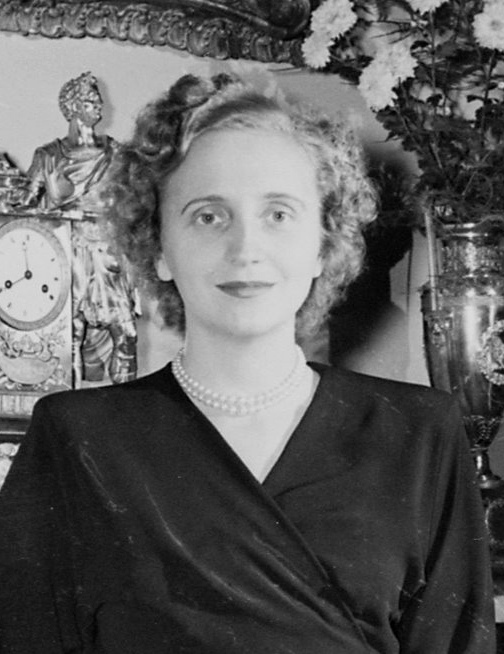
Margaret Truman, an aspiring singer and daughter of President Harry S. Truman, was 26 when she performed at Washington’s Constitution Hall before 3,500 people in December 1950. But her efforts were panned by Washington Post critic Paul Hume, who wrote that she had “a pleasant voice of little size and fair quality … cannot sing very well … is flat a good deal of the time … has not improved in the years that we have heard her … [and] still cannot sing with anything approaching professional finish.”

Hume’s review incensed President Truman, and he let Hume know about his anger in a letter written the same day. In part, it said that  “I’ve just read your lousy review of Margaret’s concert … It seems to me that you are a frustrated old man [Hume was 34] who wishes he could have been successful. When you write such poppy-cock … it shows conclusively that you’re off the beam and a least four of your ulcers are at work. Some day I hope to meet you. When that happens you’ll need a new nose, a lot of beefsteak for black eyes, and perhaps a supporter below! Pegler [Westbrook Pegler was a columnist disliked by President Truman], a gutter snipe, is a gentleman alongside you. I hope that you’ll accept that statement as a worse insult than a reflection on your ancestry.”

The letter itself was sold by Hume in 1951, and has remained in private hands since, according to the Harry S. Truman Library and Museum.  Today, the letter is reportedly among the collections of the private Harlan Crow Library in Dallas.

Margaret Truman, while finding little success as a singer, became an accomplished radio and television host. She also authored an acclaimed biography of her father, a personal biography of her mother, and nonfiction works about previous presidents and families who lived in the White House. She also wrote numerous works of fiction, primarily murder mysteries set in the Washington area, remaining active into her 80s.

Margaret married Clifton Daniel, a New York Times reporter and later managing editor of that paper, in 1956. They had four children – all boys.  Margaret was 83 when she died in 2008.  


Saturday, October 13, 2012

The Lewis & Clark air gun ... and a dangerous demonstration

As Meriwether Lewis prepared for his early 19th century trip with William Clark to explore what is today is the American Northwest, he bought an air gun – a rifle that used compressed air, stored in its stock, to shoot a large, .46 caliber lead ball about as well as any other gun of the day. Each air gun held about 22 of these balls in a magazine attached to the gun, which could be much more rapidly fired (the entire magazine in about a minute) than any muzzle-loader. The downside is that it took about 1,500 strokes of a small air pump, similar to today’s bicycle pump, to fully pressurize the gun at 600 to 800 pounds per square inch. Also, the effectiveness of the gun dropped as pressure was lost with each shot.

The Girandoni air gun.
(Photo courtesy of the U.S. Army)

Lewis enjoyed demonstrating the gun, and one of the first entries in his account of the expedition mentions an incident that could have been an ominous beginning for the trip. After Lewis demonstrated the gun to some “gentlemen” on August 30, 1830, he allowed them to inspect it. It discharged, with the ball from it striking a woman bystander, as told in Lewis’ own words (and with his own punctuation and spelling):

“Left Pittsburgh this day at 11ock with a party of 11 hands 7 of which are soldiers, a pilot and three young men on trial they having proposed to go with me throughout the voyage.  Arrived at Bruno's Island 3 miles below halted a few minutes.   went on shore and being invited on by some of the gentlemen present to try my airgun which I had purchased brought it on shore charged it and fired myself seven times fifty five yards with pretty good success; after which a Mr. Blaze Cenas being unacquainted with the management of the gun suffered her [referring to the gun] to discharge herself [again, referring to the gun] accedentaly  the ball passed through the hat of a woman about 40 yards distanc cuting her temple about the fourth of the diameter of the ball; shee fell instantly and the blood gusing from her temple  we were all in the greatest consternation  supposed she was dead by [but] in a minute she revived to our enespressable satisfaction, and by examination we found the wound by no means mortal or even dangerous; …”  

During the rest of the expedition to the West Coast, when Lewis and Clark encountered new groups of Indians, they reported demonstrating the rapid fire of the air gun. Many people who have studied the Lewis and Clark expedition believe that these demonstrations of firepower suggested that the expedition was more formidable that it was, helping ensure its continued well-being as it traveled through lands occupied only by Indians.

Based on a written description of the gun by a “gentleman” who saw it demonstrated by Lewis a few days after the unfortunate shooting of the bystander described by Lewis above, it was almost certainly a design developed earlier by G.C. Girandoni in Europe, and adopted for use in the Austrian army from the late 1700s until the early 1800s.

Saturday, October 6, 2012

An escaped German P.O.W. ... finding a new life in America

Relatively few of the hundreds of thousands of German prisoners of war held in the U.S. during World War II escaped from their prison camps. Most of them were easily captured when they couldn’t blend into American society very well. By the end of the war, when those prisoners were sent back to Germany, only 12 remained at large. And by the 1960s, all but one – a man named Georg Gaertner – hadn’t been accounted for.

Georg Gaertner, also known
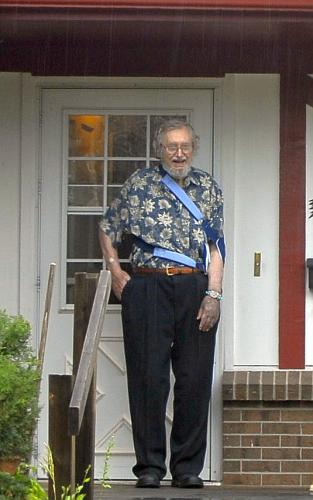
as Dennis Whiles, in 2009

As the war neared its end, Gaertner learned that his home town in Germany had been taken by the Russian army. Russian revenge against the German population in such towns was brutal, and most are now part of Poland. To avoid being sent back there and face Russian wrath, Gaertner decided to try to remain in America. On September 21, 1945, he escaped from a prison camp in New Mexico and hopped onto a freight train that took him to California.

Gaertner could speak English and had served as a prison translator, and that skill would serve him well. He took a series of odd jobs, working as a dishwasher and farm laborer and keeping a low profile as he moved from town to town to avoid attention. As he improved his English-language skills, he also learned how to fit into American life. He carried a Social Security card under the name of Dennis Whiles, married an American woman with two kids in the 1960s, and took on higher-paying jobs in construction and sales, and even as a ski instructor and tennis instructor. In the early 1980s, Gaertner’s wife – whom knew nothing of his past – became suspicious when he refused good job opportunities that would have required background checks. When she threatened to leave him, he told her the truth and decided to come clean.

Gaertner knew that he had been mentioned in a book titled Nazi Prisoners of War in America, so in November 1983 he called the author – Texas A&M University professor Arnold Krammer.

"The caller identified himself as Dennis Whiles and commented that he had enjoyed reading my book," Krammer was quoted in a 1985 Houston Chronicle article. "He also said that it was very accurate, admitting that he had once been a German prisoner of war." The men spoke for a long time, and eventually Gaertner told Krammer who he really is.
 
Krammer and Gaertner collaborated to write another book, titled Hitler's Last Soldier in America, published in 1985. Gaertner reportedly obtained U.S. citizenship in 1989 and lives today in Colorado.
 

Saturday, September 29, 2012

Jefferson ... on the "degeneracy of the human body"

Today’s Americans are continually bombarded with messages urging them to get more exercise, but even centuries ago, America’s Thomas Jefferson thought that the domestication of the horse was to blame for reducing the health of the European-Americans who rode them most often and regularly.  He questioned whether the advantages of riding were greatly outweighed, over the long run, by the disadvantages brought through a reduction in the amount of exercise his countrymen enjoyed.

His thoughts were put on paper in an August 19, 1785 letter to his 15-year-old nephew, Joseph Carr. Jefferson wrote: “The Europeans value themselves on having subdued the horse to the uses of man. But I doubt whether we have not lost more than we have gained by the use of this animal. No one has occasioned so much the degeneracy of the human body. An Indian goes on foot nearly as far in a day, for a long journey, as an enfeebled white does on his horse, and he will tire the best horses.”

Several of Jefferson’s letters include his extensive thoughts on the value of exercise – and walking in particular – are provided on the website for Monticello, his home in Virginia.

Saturday, September 22, 2012

Washington's teeth ... not for the squeamish


One of several sets of Washington's false teeth
Despite his efforts to take care of his teeth throughout his life, George Washington had only a single remaining natural tooth by the time he was inaugurated as U.S. president in 1798, according to several of his biographers. By that time, he also had his first set of full dentures, made by dentist John Greenwood, who had previously also supplied him with partial dentures that hooked to his natural teeth. All of these various sets of false teeth were made primarily of a base carved from hippopotamus ivory, into which human or cow teeth were attached. Small screws and springs were also part of these state-of-the-art 18th century dentures.

Washington’s apparently ongoing, painful problems with his teeth and these dental contraptions over many years – issues that thankfully do not confront so many Americans today – are noted in several letters he wrote. For example, at least as early as May 1781 he wrote to another dentist, John Baker, seeking his help: 

Sir, A day or two ago I requested Col. Harrison to apply to you for a pair of Pincers to fasten the wire of my teeth.  I hope you furnished him with them. I now wish you would send me one of your scrapers as my teeth stand in need of cleaning, and I have little prospect of being in Philadelph. soon.It will come very safe by the Post & in return, the money shall be sent so soon as I know the cost of it. I am Sir Yr Very Hble Serv.  G. Washington

In another letter, to the dentist Greenwood and dated February 20, 1795, Washington offers his thanks for a new set  (his first complete set?) of false teeth and writes that he is enclosing $60 in payment:

Washington, with dentures seemingly in place,
in portrait by Gilbert Stuart
Sir, Your last letter, with its accompaniment, came safe to my hands on tuesday last. Enclosed you will receive sixty dollars in Bank notes of the United States. In addition to which, I pray you to accept my thanks for the ready attention which you have at all times, paid to my requests, and that you will believe me to be, with esteem, Sir … Your very Hble Serv. G. Washington

The $60 cost of those dentures was quite a sum in the late 18th century. In today’s dollars, that amount would be roughly equivalent to $1,090.

Portraits of Washington as an older man are notable for the puffy, slightly distorted appearance of his cheeks and lips, which many historians have attributed to his false teeth. But you have to wonder if … or why … he would have kept them inside his closed mouth, which couldn’t have been comfortable, for the many hours that he stood or sat still for a portrait. Was it that his lips and cheeks would have looked even worse if he not worn his dentures in place of his nonexistent natural teeth?