Saturday, February 16, 2013

Lewis & Clark arrogance ... and "coppolating" grizzlies

American Indians hunting grizzly bears,
by George Catlin (1796-1872)
Meriwether Lewis and William Clark brought just a little arrogance with them as they explored the undeveloped northwestern United States in the very early 1800s. For example, familiar with only the relatively small black bear of the eastern United States, they discounted Native American reports of a large, ferocious brown bear – the grizzly.

Lewis and his men looked forward to meeting some of these brown bears. With an air of superiority, he wrote that the Indians had only bows and arrows or “the indifferent guns with which the traders furnish them, with these they shoot with such uncertainty and at so short a distance that they frequently miss their aim & fall a sacrifice to the bear,” as noted in Stephen Ambrose’s 1996 book Undaunted Courage: Meriwether Lewis, Thomas Jefferson, and the Opening of the American West. Lewis also noted that the Indians prepared for a bear encounter with the same types of ceremonies in which they prepared for battle against other men, but felt certain that the animals would be no match for his men’s superior arms and expertise in using them.

The expedition’s first encounter with the grizzly was a little disconcerting. Lewis and another man, walking on the shore of the river on which their boats traveled, shot two bears. One ran away, but the other charged Lewis and pursued him for about 80 yards. He and the other man were able to reload their guns and shoot the animal again, killing it. Although this bear was not full-grown, it began to earn some respect for its species from Lewis, who wrote that it is “astonishing to see the wounds they will bear [certainly he meant no pun?] before they can be put to death.” He added, though, that “in the hands of a skilled rifleman [the bears] are by no means as formidable or dangerous” as the Indians believe, Ambrose reported in his book.

The next encounter, a few days later, ended with the death of another bear, but it wasn’t easy. Lewis described “a most tremendious [correct spelling wasn’t Lewis’ strongpoint] looking anamal, and extremely hard to kill notwithstanding he had five balls through his lungs and five other in various parts he swam more than half the distance across the river to a sandbar & it was at least twenty minutes before he died.”

The expedition came across another grizzly a week later, but it ran away before it could be attacked, to which Lewis wrote that “I find that the curiosity of our party is pretty well satisfied with respect to this anamal.” The bears’ size and ferocity “has staggered the resolution [of] several of [the men], others however seem keen for action with the bear,” Lewis added.

Of those who looked forward to additional encounters with the grizzlies, Lewis added a bit of humor:  “I expect these gentlemen will give us some amusement shotly as [the bears] begin now to coppolate.”

Saturday, February 9, 2013

The swastika ... before Hitler and the Nazis

 
The front of a postcard mailed from New York
to Connecticut in 1910.
Before Hitler and the Nazis made it their symbol beginning in the 1930s, the swastika was a favorable, positive image among many cultures around the world for thousands of years.


“The first appearance of the swastika was apparently in the Orient, precisely in what country it is impossible to say, but probably in Central and Southeastern Asia among the forerunners or predecessors of the [Hindus of India and Nepal] and Buddhists,” wrote Thomas Wilson, curator of the U.S. National Museum, in his 1896 book titled The Swastika: The Earliest Known Symbol, and Its Migration; with Observations on the Migration of Certain Industries in Prehistoric Times (free Kindle edition or free Google Books edition).

Swastikas adorn pottery, dating
to about 780 B.C., from Greece.
The word itself comes from the ancient Sanskrit language, still in use in Hindu religious liturgies and Buddhist scholarly works. In Sanskrit, “svastika” derives from the smaller words “su,” conveying something positive, such as goodness or wellness or life (from what I can tell, there’s not really a direct translation in English), and “asti,”meaning “to be.” Adding a “ka” on the end makes it a noun – giving us “svastika” in Sanskrit today. And, of course, that easily becomes “swastika” in English.
 
Swastikas embedded in the design
of a weight used in Ghana
to determine gold amounts.
After spreading throughout the world, and perhaps developing independently among different cultures as well, the symbol became especially popular as a sign of good luck in Europe and the United States at the beginning of the 20th century. Some scholars trace that development to archaeologist Heinrich Schliemann’s 19th century discovery of swastikas in the ruins of the ancient city of Troy. Noting their similarity to swastikas he had seen at archeological sites in Germany, and knowing of the symbol’s prevalence in ancient Indian civilization, Schliemann concluded that all three cultures – advanced ancient civilizations in India and near the Mediterranean Sea (such as Troy) as well as the less-impressive ancient cultures in Germany – must be closely related. Other Europeans took that to heart, too, as did the many Americans with strong ethnic ties to Europe. Soon, the symbol was not uncommon throughout the U.S., and a U.S. Army division even used it as a logo before World War II.
 
Swastikas on uniforms of the basketball team
from the Chilocco Indian Agricultural School,
Oklahoma, in 1909.
Other evidence that would seem to void that conclusion was overlooked, or perhaps even inexplicably dismissed. For example, the swastika was known to American Indian cultures long before Europeans arrived on American shores. So the European-American pride in the swastika seemed to swell in the early 1900s, and Hitler and his Nazi party took that to the extreme in their warped visions, believing that they represented a master race that was the modern incarnation of that ancient lineage. They co-opted the swastika, making a mockery of that distinctive design’s long history as a symbol of good in the world.

“Regardless of its context, I still cringe every time I see the mark, yet I’m continually drawn to it – perhaps in the same way that others have been drawn to it over the millenia,” writes Steven Heller, a long-time art director at the New York Times, in his 2008 book The Swastika: Symbol Beyond Redemption?Food for thought.
 

Saturday, February 2, 2013

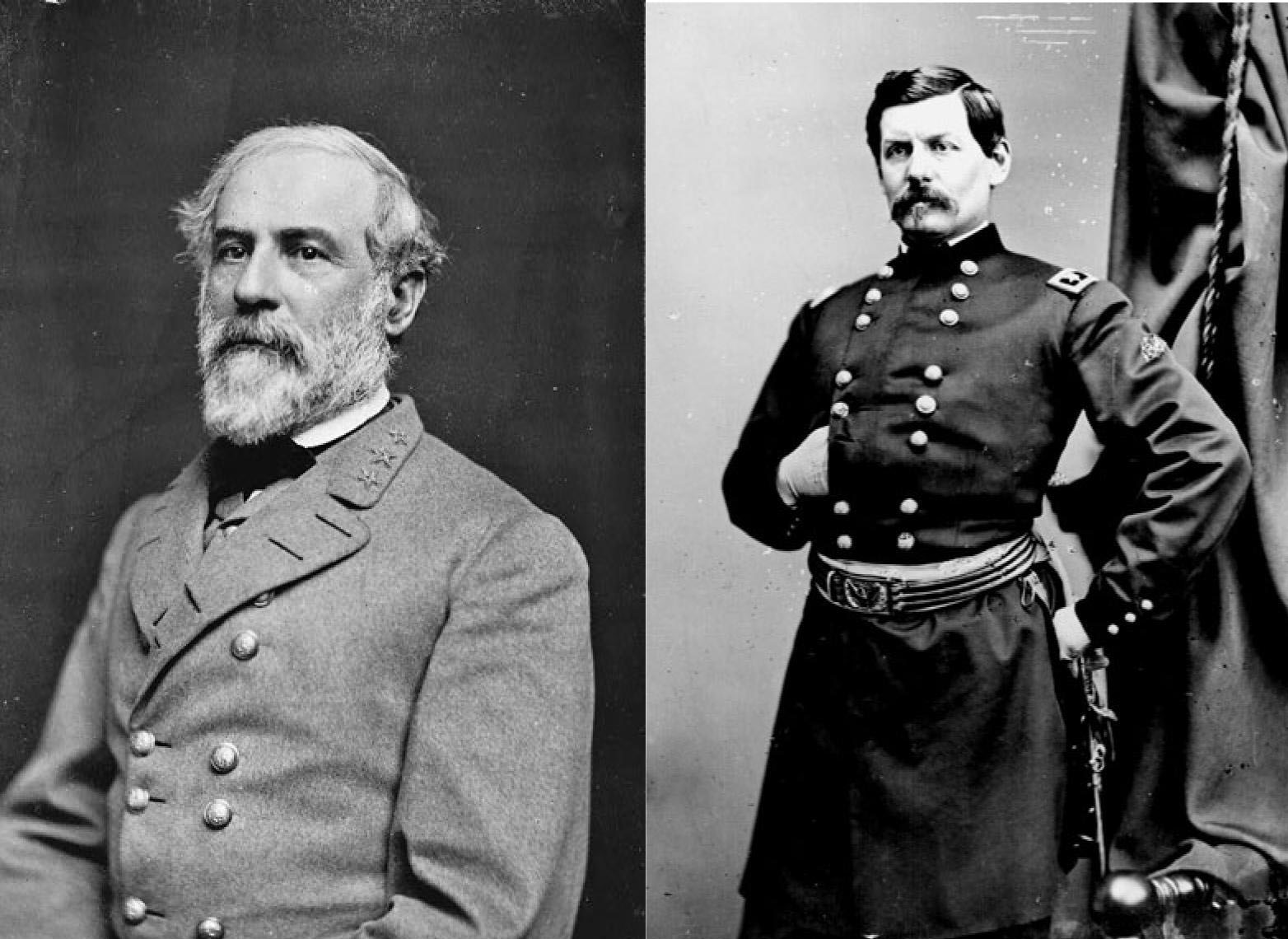
The North's General George McClellan ... and underestimating the South's Robert E. Lee

Confederate General Robert E. Lee (left)
and Union General George B. McClellan (right)
As the Civil War ramped up in 1862, Union General George B. McClellan was glad that Robert E. Lee replaced the wounded Joseph Johnston as commander of the Army of Northern Virginia, one of the major Confederate forces in the Civil War. McClellan had known both Lee and Johnston when all three men served in the U.S. Army prior to the war. McClellan believed that Lee would be a less formidable foe compared to Johnston.

“I prefer Lee to Johnston – the former is too cautious & weak under grave responsibility – personally brave & energetic to a fault, he yet is wanting in moral firmness when pressed by heavy responsibility & is likely to be timid and irresolute in action,” wrote McClellan to U. S. President Abraham Lincoln.

Although Lee had a bit of experience as a field commander earlier in the war, he was serving as an adviser to Confederate President Jefferson Davis when the appointment was made. At that time, approximately 105,000 Union troops under McClellan were advancing on the Confederacy’s capital city – Richmond, Virginia – which was defended by approximately 60,000 men. After assuming command of the Confederate Army, Lee initiated a series of surprise attacks and major counter-offensives that kept McClellan off guard and ended the threat to Richmond. For much of the rest of the war, Lee often out-maneuvered larger Union forces, proving much of McClellan’s judgment of him to be far from accurate.

Saturday, January 26, 2013

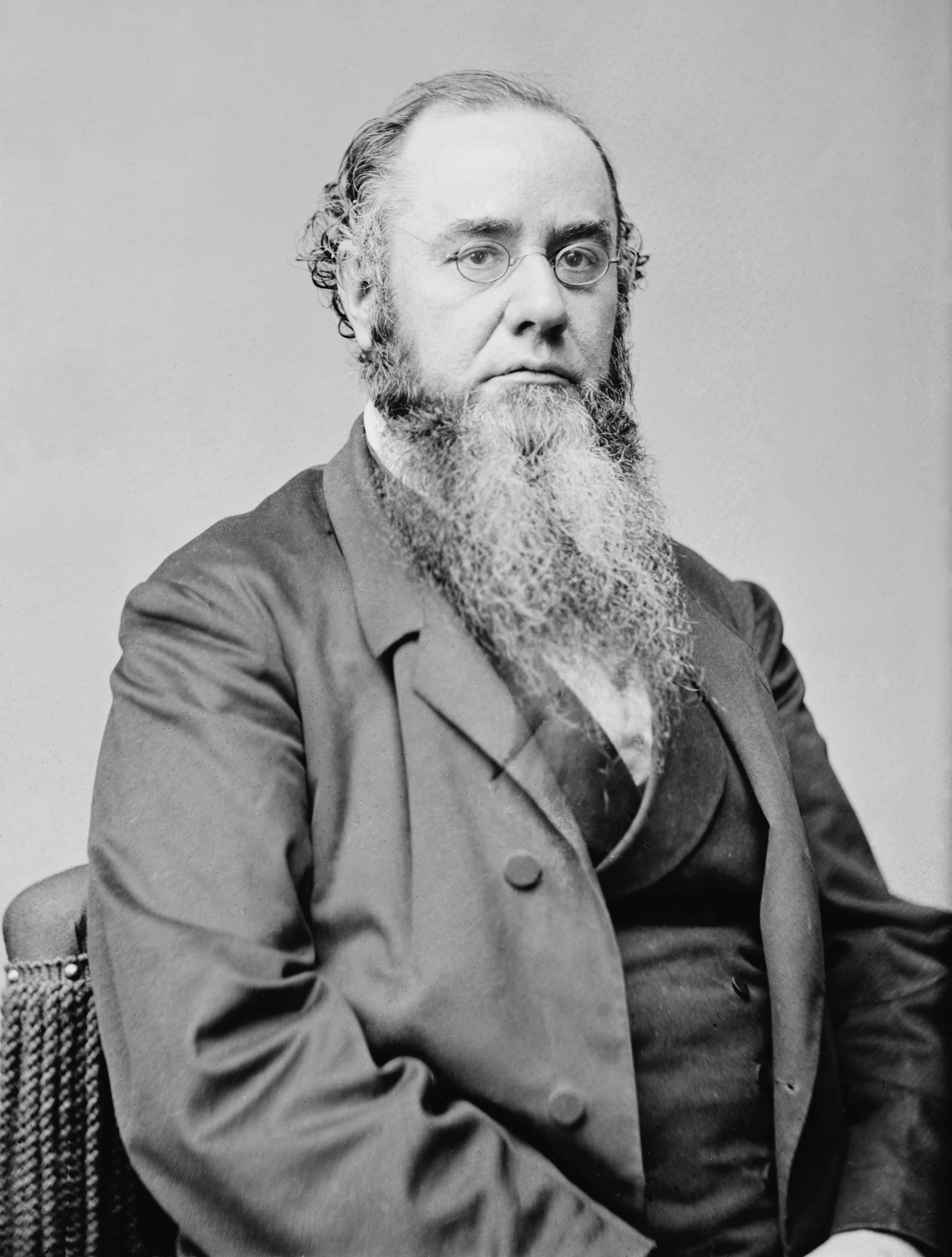
Edwin M. Stanton ... greatly unimpressed upon meeting Lincoln

Edwin M. Stanton,
sometime between 1855 and 1865
Within a year after Republican Abraham Lincoln was inaugurated as U.S. President in 1861, he appointed the very competent but ill-tempered attorney Edwin M. Stanton as Secretary of War. Not only was this appointment a surprise because Stanton was a Democrat, but because of Stanton’s role in humiliating Lincoln years earlier, when both men were supposed to be on the same side in an important trial.

The year was 1855, and Cyrus McCormick, who had invented and patented a mechanical wheat reaper, filed a lawsuit against John H. Manny, who had developed a similar machine and was manufacturing it in Illinois. Manny hired two of the nation’s most prominent patent lawyers – George Harding and Peter H. Watson, as well as an up-and-coming attorney named Stanton (Lincoln’s future cabinet member). Because the trial was originally set for Chicago, Watson – although not tremendously impressed with the disheveled-looking Lincoln – hired him as a local attorney who would be familiar to Illinois judges. Watson gave Lincoln a $500 retainer and promised the future president that he would give the closing argument in the trial.

“Lincoln determined to give this case his most careful preparation,” wrote Ronald C. White Jr. in his 2009 biography titled A. Lincoln: A Biography. But Lincoln received no further word from other attorneys on the Manny team, even after requesting copies of depositions that had been taken in the case.

Two weeks before the trial was set to begin, it was transferred to Cincinnati, Ohio. Lincoln received word of the change, and on the day the trial began, he tried unsuccessfuly to join the other members of the Manny legal team as they entered the courthouse.  Lincoln at the time was later described by Harding as “a tall rawly boned, ungainly back woodsman, with coarse, ill-fitting clothing.” Stanton was arguably even less impressed, later reportedly describing to a friend the encounter with a “long, lank creature from Illinois, wearing a dirty linen duster for a coat, on the back of which the perspiration had splotched two wide stains that, emanating from each armpit, met at the center, and resembled a dirty map of a continent.” 

During the week-long trial, “the defense team never included Lincoln in their deliberations, nor even invited him to join them for their meals at the hotel. Judge John McLean entertained all the lawyers at a dinner at his home, but Lincoln was not invited,” writes White.  If any doubt remained, Lincoln also learned that he would not give the closing argument, that the brief he had prepared had not been opened, and that he would have no role in the trial.

Lincoln watched the proceedings as a spectator. After the court ruled in favor of Manny, Lincoln returned to his office and home in Springfield, Illinois and told his law partner that he had been “roughly handled by that man Stanton.”

Following the trial, the Manny legal team’s Watson sent Lincoln a check for his participation. Lincoln returned it, saying he had contributed nothing to the trial, but Watson sent it back to him. Ultimately, Lincoln cashed the check – and also recognized that Stanton's knowledge and skills, if not his conceit and arrogance, would be of great value to the country.

Saturday, January 19, 2013

Paul Revere ... less successful than others on that night

Paul Revere, circa 1768-1770
(Painting by John Singleton Copley)
Paul Revere today gets most of the credit for warning American patriots at Concord and Lexington that British soldiers were marching toward them from Boston in April 1785, but Revere was among the least successful of many messengers on similar missions that night.  Revere did reach Lexington, where he told patriots Samuel Adams and John Hancock, but he was captured by British soldiers as he rode to on to Concord. They took his horse and released him, and he walked back to Lexington.

But many others also rode or walked or rang bells or shot guns that night to successfully spread word of the British advance (which was not unexpected). In his 2004 book Founding Myths: Stories That Hide Our Patriotic Past, historian Ray Raphael cites the work of another historian, David Hackett Fischer, who in 1994 identified dozens of people who were involved in passing along that night’s news through the New England countryside.

To be sure, Revere was a committed patriot who was involved in many of the events that led to the American Revolution.  But why has his Boston-to-Lexington ride, which was no great, singularly vital fete on a night when so many others made equal or greater contributions, won so much acclaim in popular American history? Revere himself made no special note of his actions that night in later accounts, and neither did his 1818 obituary. And historians over many decades didn’t mention it much, if at all, until the later 1800s – after Henry Wadsworth Longfellow’s poem “Paul Revere’s Ride” was published in January 1861.
 
“Paul Revere’s Ride” is a stirring, memorable piece of art, proof of Longfellow’s talent, from its very beginning:

“Listen, my children, and you shall hear
Of the midnight ride of Paul Revere …”

And much for that reason, it became – and remains – well-entrenched in American culture even today. Unfortunately, its many historical inaccuracies have been repeated so much that they are often mistaken for fact.

“Although ‘Paul Revere’s Ride’ has enjoyed more exposure than any other historic poem in American culture, it is riddled with distortions,” wrote Raphael. “These are not incidental – they are the very reasons the story has endured for almost a century and a half.”
 
So no, Paul Revere wasn't by any stretch the only person trying to warn other patriots that night, as Longfellow implies. And no, Paul Revere didn't reach his most important destination the village of Concord (although others did), as Longfellow wrote. And no, contrary to Longfellow, Paul Revere did not receive a signal from two lamps in the steeple of the Old North Church; Revere arranged for that signal to be sent. We could go on with troublesome parts of this supposed historical narrative set to the tune of great lyrical poetry ... but will end with a caution to avoid mistaking emotionally stirring art  whether in poetry, a novel, a painting, a film, or another medium  for historical fact.
 

Sunday, December 23, 2012

When celebrating Christmas was illegal in America ...

The History Insider offered this item before Christmas a year ago, but thought it worth mentioning again for those who missed it or those find it interesting enough to want to be reminded.
____________________

Were America’s early English settlements home to widespread mirth and joy during the Christmas season? Did many of America’s English settlers – especially the most pious groups, such as the Puritans -- have a strong affinity to Christmas celebrations and what they represent? The answer, perhaps surprisingly, is no. In fact, some of those first people to successfully settle in the New England had a strong aversion to Christmas celebrations, notes historian Stephen Nissenbaum in his book The Battle for Christmas.

“In New England, for the first two centuries of white settlement most people did not celebrate Christmas,” writes Nissenbaum. “In fact, the holiday was systematically suppressed by Puritans during the colonial period and largely ignored by their descendants. … It was actually illegal to celebrate Christmas in Massachusetts between 1659 and 1681 (the fine was five shillings) …Puritans were fond of saying that if God had intended for the anniversary of the Nativity to be observed, He would surely have given some indication as to when that anniversary occurred.” Indeed, many scholars report that there is no biblical reference to December 25 as the date of Jesus Christ’s birth.
Nissenbaum also notes, among other interesting details, that Puritans had other reasons for opposing Christmas celebrations, too, based largely on what they had witnessed of those events – “… rowdy public displays of excessive eating and drinking, the mockery of established authority, aggressive begging (often involving the threat of doing harm), and even the invasion of wealthy homes.”

Saturday, December 8, 2012

Russian diplomats ... and American bread

Arkady N. Shevchenko – who in 1978 became the highest ranking official of the Soviet Union to defect to the United States – traveled to New York from Russia for the first time in 1958, on a three-month assignment as part of a Soviet delegation to the United Nations General Assembly.

In his 1985 book Breaking with Moscow, Shevchenko wrote of meals he took as he lived with his countrymen in a compound owned by his government in this first visit:  

“The cook was from Russia, but the food didn’t taste Russian – milk and eggs, among other foods, had different flavors. But it was the bread that gave us our biggest shock:  packaged white bread from a supermarket had the flavor and texture of glue. We couldn’t get over the idea that Americans really bought it and seemed to like it. If the bread was disappointing, however, there was nothing better than Coca-Cola; we drank it by the gallon during the warm autumn days.”

By the time Shervchenko defected 20 years after this initial visit to America, he had risen through the Soviet and United Nations systems to become the U. N.’s Undersecretary General, the No. 2 person in that body, behind only the Secretary General.

Shevchenko died at 67 in Maryland in 1998. He is buried in Washington, D.C.

Saturday, November 10, 2012

Meriwether Lewis, of Lewis & Clark fame ... shot in the butt

Through its unprecedented exploration of what is today northwestern America from 1804 to 1806, the Lewis and Clark expedition lost only one man (due apparently to appendicitis, very early on the journey) of the 30-plus men, one woman, and an infant who traveled more than 7,000 miles (from St. Louis to the Pacific and back) over vast, undeveloped and uncharted territories occupied by unfamiliar Indian tribes.  But the expedition came close to losing one of its leaders – Meriwether Lewis – when he was shot in the butt by one of his men in what seems to have been a hunting accident.

The incident occurred on the return journey, just off the Missouri River in what is today northwestern North Dakota. Lewis and the expedition’s other leader, William Clark, had split up, each taking a part of their men on different paths so that even more of the lands recently brought into the country through the Louisiana Purchase could be explored. On August 11, 1806, as Lewis and his group traveled down the Missouri, they stopped to go onshore and hunt for elk they had seen.  Lewis took one of his men, a Private Cruzatte, for the effort. The men became separated, and as Lewis raised his rifle to his shoulder for a shot, he himself was hit by a rifle bullet that entered his left butt cheek “an inch below his hip joint” and exited through his right butt cheek, “leaving a three-inch gash the width of the ball,” wrote Stephen E. Ambrose in his 1996 book Undaunted Courage: Meriwether Lewis, Thomas Jefferson, and the Opening of the American West.

Lewis called out to Cruzatte, but got no answer. Fearing an Indian attack, the severely wounded Lewis somehow made his way back to his other men on the river. He tried to lead them back to site of the shooting to save Cruzatte, but his injury became too painful and debilitating, so he told his men to leave him behind. Lewis struggled back to the boats on the river and armed himself, later writing that he “determined to sell my life as deerly as possible.” After about 20 minutes, the men returned with Cruzatte, who seemed oblivious to what had happened, and said he had not heard Lewis call out to him after he had been shot. Cruzatte denied being the culprit. But the bullet, which had lodged in Lewis’s leather breeches, was from the same type of late-model U.S. Army rifle carried by Cruzatte, which was not a weapon likely to be in the hands of a hostile Indian.

Lewis himself was the closest thing to a doctor on the expedition, although he had little training in the field – only a two-week tutelage under one of America’s leading medical experts, Dr. Benjamin Rush, as in preparation for the expedition. So Lewis dressed his wound himself, placing roles of lint into the holes in his butt. He was forced to lie on his stomach and the boats continued down the river. The pain became so great that he couldn’t be moved, so he spent the night, after the group made camp on the shore of the river, on his stomach in one of the boats. He became feverish, but the application of a poultice of Peruvian bark, seemed to control that, but not the pain.  

Lewis’ group rejoined Clark’s group the next day. Lewis was still on his belly, and fainted with pain when Clark changed the dressings on the wounds. Over the next days, the wounds appeared to be healing, but still Lewis couldn’t walk.  Improvement was again noted on August 22, when Clark wrote that Lewis “walked a little to day for the first time. I have discontinued the [lint] in the hole the ball came out.”  And the next day, Clark wrote that Lewis “is recovering fast the hole in his thy where the Ball passed out is Closed and appears to be nearly well. The one where the ball entered discharges very well.”
 
There were setbacks in Lewis’ recovery, though. Clark reported a few days later that Lewis“hurt himself very much by takeing a longer walk ... than he had Strength to undergo, which Caused him to remain very unwell all night.” The next morning, Clark wrote that Lewis“had a bad nights rest and is not very well this morning.” But by the time the expedition returned to St. Louis about a month later, in late September 1806, Lewis seems to have fully recovered.

Saturday, October 27, 2012

George Washington ... "Cards & other Play"

As a general, George Washington forbade gambling among his men, calling it “the child of avarice, the brother of iniquity and the father of mischief.” But in his private life, before being appointed head of the Continental Army, he enjoyed betting on “Cards & other Play” – the title he gave to a page of the extensive records he kept, in his own handwriting, of all types of financial transactions he made during his life.  Those entries in his so-called Ledger B note how much he won, how much he lost, and where he played from 1772 to early 1775.

During those years, he recorded playing 64 times, coming out ahead – financially speaking – 28 times and behind 36 times.  His biggest one-day (or perhaps one-night) losses were 6.5 pounds on two dates, March 28, 1772 and April 6, 1772, when he played at Williamsburg, Virginia. The most he earned came on October 7, when he played at Annapolis, Virginia and earned a whopping 13.7 pounds.

During this period, before the American Revolution, Washington was a well-known Virginia planter and landowner, apparently enjoying the good life. He represented Fairfax County in the Virginia House of Burgesses, which met in Williamsburg. As the Burgesses took steps toward criticizing the British Crown, Virginia’s Royal Governor dissolved the organization in 1774. In response to this and other grievances, American patriots held their First Continental Congress, which met in September and October of 1774. Washington was one of the representatives from Virginia, and recorded “Cards & other Play” items in his ledger only twice after that point, and never after he was appointed commander of the patriots’ Continental Army by the Second Continental Congress in 1775. But it's hard to believe that he gave it up for good!

Saturday, October 20, 2012

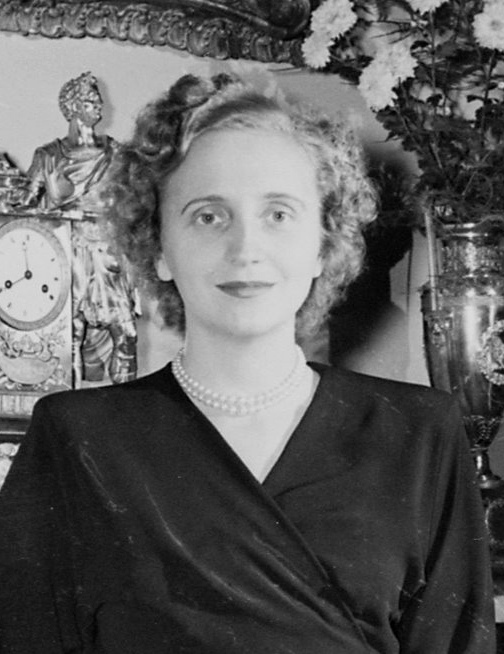
President Truman ... backing his daughter's singing abilities

Margaret Truman
(undated photo)
Margaret Truman, an aspiring singer and daughter of President Harry S. Truman, was 26 when she performed at Washington’s Constitution Hall before 3,500 people in December 1950. But her efforts were panned by Washington Post critic Paul Hume, who wrote that she had “a pleasant voice of little size and fair quality … cannot sing very well … is flat a good deal of the time … has not improved in the years that we have heard her … [and] still cannot sing with anything approaching professional finish.”

Hume’s review incensed President Truman, and he let Hume know about his anger in a letter written the same day. In part, it said that  “I’ve just read your lousy review of Margaret’s concert … It seems to me that you are a frustrated old man [Hume was 34] who wishes he could have been successful. When you write such poppy-cock … it shows conclusively that you’re off the beam and a least four of your ulcers are at work. Some day I hope to meet you. When that happens you’ll need a new nose, a lot of beefsteak for black eyes, and perhaps a supporter below! Pegler [Westbrook Pegler was a columnist disliked by President Truman], a gutter snipe, is a gentleman alongside you. I hope that you’ll accept that statement as a worse insult than a reflection on your ancestry.”

The letter itself was sold by Hume in 1951, and has remained in private hands since, according to the Harry S. Truman Library and Museum.  Today, the letter is reportedly among the collections of the private Harlan Crow Library in Dallas.

Margaret Truman, while finding little success as a singer, became an accomplished radio and television host. She also authored an acclaimed biography of her father, a personal biography of her mother, and nonfiction works about previous presidents and families who lived in the White House. She also wrote numerous works of fiction, primarily murder mysteries set in the Washington area, remaining active into her 80s.

Margaret married Clifton Daniel, a New York Times reporter and later managing editor of that paper, in 1956. They had four children – all boys.  Margaret was 83 when she died in 2008.  


Saturday, October 13, 2012

The Lewis & Clark air gun ... and a dangerous demonstration

As Meriwether Lewis prepared for his early 19th century trip with William Clark to explore what is today is the American Northwest, he bought an air gun – a rifle that used compressed air, stored in its stock, to shoot a large, .46 caliber lead ball about as well as any other gun of the day. Each air gun held about 22 of these balls in a magazine attached to the gun, which could be much more rapidly fired (the entire magazine in about a minute) than any muzzle-loader. The downside is that it took about 1,500 strokes of a small air pump, similar to today’s bicycle pump, to fully pressurize the gun at 600 to 800 pounds per square inch. Also, the effectiveness of the gun dropped as pressure was lost with each shot.

The Girandoni air gun.
(Photo courtesy of the U.S. Army)

Lewis enjoyed demonstrating the gun, and one of the first entries in his account of the expedition mentions an incident that could have been an ominous beginning for the trip. After Lewis demonstrated the gun to some “gentlemen” on August 30, 1830, he allowed them to inspect it. It discharged, with the ball from it striking a woman bystander, as told in Lewis’ own words (and with his own punctuation and spelling):

“Left Pittsburgh this day at 11ock with a party of 11 hands 7 of which are soldiers, a pilot and three young men on trial they having proposed to go with me throughout the voyage.  Arrived at Bruno's Island 3 miles below halted a few minutes.   went on shore and being invited on by some of the gentlemen present to try my airgun which I had purchased brought it on shore charged it and fired myself seven times fifty five yards with pretty good success; after which a Mr. Blaze Cenas being unacquainted with the management of the gun suffered her [referring to the gun] to discharge herself [again, referring to the gun] accedentaly  the ball passed through the hat of a woman about 40 yards distanc cuting her temple about the fourth of the diameter of the ball; shee fell instantly and the blood gusing from her temple  we were all in the greatest consternation  supposed she was dead by [but] in a minute she revived to our enespressable satisfaction, and by examination we found the wound by no means mortal or even dangerous; …”  

During the rest of the expedition to the West Coast, when Lewis and Clark encountered new groups of Indians, they reported demonstrating the rapid fire of the air gun. Many people who have studied the Lewis and Clark expedition believe that these demonstrations of firepower suggested that the expedition was more formidable that it was, helping ensure its continued well-being as it traveled through lands occupied only by Indians.

Based on a written description of the gun by a “gentleman” who saw it demonstrated by Lewis a few days after the unfortunate shooting of the bystander described by Lewis above, it was almost certainly a design developed earlier by G.C. Girandoni in Europe, and adopted for use in the Austrian army from the late 1700s until the early 1800s.

Saturday, October 6, 2012

An escaped German P.O.W. ... finding a new life in America

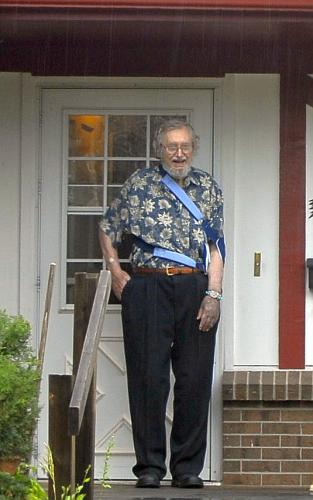
Relatively few of the hundreds of thousands of German prisoners of war held in the U.S. during World War II escaped from their prison camps. Most of them were easily captured when they couldn’t blend into American society very well. By the end of the war, when those prisoners were sent back to Germany, only 12 remained at large. And by the 1960s, all but one – a man named Georg Gaertner – hadn’t been accounted for.

Georg Gaertner, also known
as Dennis Whiles, in 2009

As the war neared its end, Gaertner learned that his home town in Germany had been taken by the Russian army. Russian revenge against the German population in such towns was brutal, and most are now part of Poland. To avoid being sent back there and face Russian wrath, Gaertner decided to try to remain in America. On September 21, 1945, he escaped from a prison camp in New Mexico and hopped onto a freight train that took him to California.

Gaertner could speak English and had served as a prison translator, and that skill would serve him well. He took a series of odd jobs, working as a dishwasher and farm laborer and keeping a low profile as he moved from town to town to avoid attention. As he improved his English-language skills, he also learned how to fit into American life. He carried a Social Security card under the name of Dennis Whiles, married an American woman with two kids in the 1960s, and took on higher-paying jobs in construction and sales, and even as a ski instructor and tennis instructor. In the early 1980s, Gaertner’s wife – whom knew nothing of his past – became suspicious when he refused good job opportunities that would have required background checks. When she threatened to leave him, he told her the truth and decided to come clean.

Gaertner knew that he had been mentioned in a book titled Nazi Prisoners of War in America, so in November 1983 he called the author – Texas A&M University professor Arnold Krammer.

"The caller identified himself as Dennis Whiles and commented that he had enjoyed reading my book," Krammer was quoted in a 1985 Houston Chronicle article. "He also said that it was very accurate, admitting that he had once been a German prisoner of war." The men spoke for a long time, and eventually Gaertner told Krammer who he really is.
 
Krammer and Gaertner collaborated to write another book, titled Hitler's Last Soldier in America, published in 1985. Gaertner reportedly obtained U.S. citizenship in 1989 and lives today in Colorado.
 

Saturday, September 29, 2012

Jefferson ... on the "degeneracy of the human body"

Today’s Americans are continually bombarded with messages urging them to get more exercise, but even centuries ago, America’s Thomas Jefferson thought that the domestication of the horse was to blame for reducing the health of the European-Americans who rode them most often and regularly.  He questioned whether the advantages of riding were greatly outweighed, over the long run, by the disadvantages brought through a reduction in the amount of exercise his countrymen enjoyed.

His thoughts were put on paper in an August 19, 1785 letter to his 15-year-old nephew, Joseph Carr. Jefferson wrote: “The Europeans value themselves on having subdued the horse to the uses of man. But I doubt whether we have not lost more than we have gained by the use of this animal. No one has occasioned so much the degeneracy of the human body. An Indian goes on foot nearly as far in a day, for a long journey, as an enfeebled white does on his horse, and he will tire the best horses.”

Several of Jefferson’s letters include his extensive thoughts on the value of exercise – and walking in particular – are provided on the website for Monticello, his home in Virginia.

Saturday, September 22, 2012

Washington's teeth ... not for the squeamish


One of several sets of Washington's false teeth
Despite his efforts to take care of his teeth throughout his life, George Washington had only a single remaining natural tooth by the time he was inaugurated as U.S. president in 1798, according to several of his biographers. By that time, he also had his first set of full dentures, made by dentist John Greenwood, who had previously also supplied him with partial dentures that hooked to his natural teeth. All of these various sets of false teeth were made primarily of a base carved from hippopotamus ivory, into which human or cow teeth were attached. Small screws and springs were also part of these state-of-the-art 18th century dentures.

Washington’s apparently ongoing, painful problems with his teeth and these dental contraptions over many years – issues that thankfully do not confront so many Americans today – are noted in several letters he wrote. For example, at least as early as May 1781 he wrote to another dentist, John Baker, seeking his help: 

Sir, A day or two ago I requested Col. Harrison to apply to you for a pair of Pincers to fasten the wire of my teeth.  I hope you furnished him with them. I now wish you would send me one of your scrapers as my teeth stand in need of cleaning, and I have little prospect of being in Philadelph. soon.It will come very safe by the Post & in return, the money shall be sent so soon as I know the cost of it. I am Sir Yr Very Hble Serv.  G. Washington

In another letter, to the dentist Greenwood and dated February 20, 1795, Washington offers his thanks for a new set  (his first complete set?) of false teeth and writes that he is enclosing $60 in payment:

Washington, with dentures seemingly in place,
in portrait by Gilbert Stuart
Sir, Your last letter, with its accompaniment, came safe to my hands on tuesday last. Enclosed you will receive sixty dollars in Bank notes of the United States. In addition to which, I pray you to accept my thanks for the ready attention which you have at all times, paid to my requests, and that you will believe me to be, with esteem, Sir … Your very Hble Serv. G. Washington

The $60 cost of those dentures was quite a sum in the late 18th century. In today’s dollars, that amount would be roughly equivalent to $1,090.

Portraits of Washington as an older man are notable for the puffy, slightly distorted appearance of his cheeks and lips, which many historians have attributed to his false teeth. But you have to wonder if … or why … he would have kept them inside his closed mouth, which couldn’t have been comfortable, for the many hours that he stood or sat still for a portrait. Was it that his lips and cheeks would have looked even worse if he not worn his dentures in place of his nonexistent natural teeth?


Saturday, September 15, 2012

President Hoover ... authorizing a break-in

As the Great Depression continued in the early 1930s, U.S. President Herbert Hoover faced growing criticism, and that bothered him greatly – so much that he went to great, and illegal, attempts to stem it, writes Christopher Andrew in his 1996 book For the President's Eyes Only: Secret Intelligence and the American Presidency from Washington to Bush.

It seems that Lawrence Richey, Hoover’s personal assistant who previously worked closely with the Secret Service, ensured that people on the president’s enemies list were kept under surveillance as needed. And possibly as a result of that effort, Hoover received a report indicating that New York Democrats had collected some type of information – its nature unknown – that would damage him politically.

Hoover turned to a former aide, Lewis Lichtenstein Strauss, to find out more. Strauss approached U.S. Navy intelligence officer Glenn Howell, who wrote in his log, according to Andrew’s book: “Strauss told me that the President is anxious to know what the contents of the mysterious documents are, and Strauss is authorized by the President to use the services of any one of our various government secret services.”

When Howell and another man broke into the office in which the damaging information was said to be held, they found it vacant.  So then they identified and followed the former tenant, a Democratic operative named James J. O’Brien.

“We shadowed him for a bit and then came to the conclusion that no President of the United States need be afraid of a ham-and-egger [someone not possessing any particularly striking qualities] like O’Brien,” Howell later wrote. He added that after reporting their findings, they received word to end the operation.
 
The incident remained secret for many years, but became public after Rutgers University history professor Jeffrey M. Dorwart discovered evidence of it in the early 1980s.
 

Saturday, September 8, 2012

The 3 a.m. president ... not whom you might think

Most of us who've worked in large organizations, whether public or private, know that the process for making big decisions can be surprising. No matter how many formal procedures are established, decision-making often comes down to the whims of people on whom the final choice depends. And the White House is no exception.

In his 1997 book Confessions of a White House Ghostwriter: Five Presidents and Other Political Adventures, former presidential speechwriter James C. Humes, who served in the Eisenhower, Nixon, Ford, and Reagan administrations, offered some interesting insight into this phenomenon:

“Sometimes – even if the general details of a legislative message have been hammered out – unagreed matters remain because of fights between competing departments. As the various drafts of the proposed message are relayed to various cabinet heads for approval, one cabinet secretary knocks out one work or item and his rival puts it back in. A change goes in – then it’s taken out.  … The hours pass from late night into the wee hours of the next day, when the president is scheduled to deliver the message. Finally, the department heads to go bed and final decision is left to the (speech)writer – hence the 3 a.m. president," Humes wrote.

“I remember one message on mass transit by President Nixon. The bone of contention was funding” from either the gasoline tax or general revenues, he wrote. “I had to decide. I chose general revenues. Strangely, my decision drew no backlash. Everyone assumed the president had made the decision.”

Saturday, September 1, 2012

Roosevelt ... the target of a hapless U.S. Navy ship


Security might have been tight when U.S. President Franklin Roosevelt traveled secretly across the Atlantic on an American battleship as the first part of a journey to meet with Britain’s Winston Churchill and Russia’s Joseph Stalin in Tehran, Iran for a discussion of the war in late 1943 – but that mattered little when another American warship providing “protection” sent a live torpedo toward the ship carrying Roosevelt.
The story, relayed through a few newspaper accounts and a 1994 article by naval historian Kit Bonner in The Retired Officer Magazine, reproduced on the USS Iowa Veteran's Association website, goes something like this: Roosevelt was aboard the USS Iowa, which was accompanied by three smaller warships for the voyage in November 1943. After the convoy passed Bermuda, weather balloons were launched from the Iowa for a demonstration of the big ship’s anti-aircraft guns. Some of the balloons drifted into the area of the destroyer USS William D. Porter, one of the escort ships. The Porter’s captain – Lt. Commander Wilfred Walter – sent his crew to battle stations to join in the anti-aircraft gun show for Roosevelt. Walter also decided, although it’s not clear from published accounts if this was a planned part of the demo or not, to simulate a torpedo attack against the Iowa.
The torpedoes were supposed to be disarmed before firing, but one was not – and it quickly made its way toward the Iowa and Roosevelt, much to the horror of Walter and his officers and crew. After a few frantic attempts to contact the Iowa through signaling, the Porter broke the radio silence that had been in force for the voyage and informed the Iowa of the mistake. The Iowa turned in time to avoid the torpedo, which exploded behind the ship, after hitting its wake.
 
Fearing an assassination attempt on Roosevelt, the Iowa trained its guns on the Porter, but backed down after Walter told of the mistake. But Walter and his entire crew were ordered back to Bermuda with their ship. Ultimately, a crewman was found guilty in a court martial and sentenced to 14 years of hard labor for his mistake and attempt to destroy evidence, but Roosevelt overrode that punishment. Walter and at least some of his officers reportedly found themselves in dead-end Navy positions after the incident, too.

Unfortunately, the Porter seemed to be jinxed, finding itself on the wrong end of this and other mishaps throughout the war, as Bonner noted in the article referenced above. The ship met its end in an unusual way, too, in June 1945. A Japanese kamikaze, or suicide, plane carrying a large bomb failed to hit the Porter, but crashed alongside, without its payload exploding on impact. The plane slowly sunk under the water, where its huge bomb finally exploded, ripping apart the Porter’s hull under its waterline. The ship sank within hours.


Saturday, August 25, 2012

Amelia Earhart ... a reluctant bride


Six years before aviation pioneer Amelia Earhart and her navigator mysteriously disappeared over the South Pacific while attempting to fly a plane around the world in 1937, she married publisher and publicist George Putnam after he asked for the sixth time – but not before making it clear that she would in no way be a lesser partner in the union. On their wedding day, she gave Putnam a note that he made public after her disappearance, calling it “brutal in its frankness but beautiful in its honesty.” An objective reader might also wonder why Earhart went through with the wedding, based on her words.

Putnam’s typed version of the letter, dated February 7, 1931, is part of Purdue University’s George Palmer Putnam Collection of Amelia Earhart papers. It is addressed to “GPP” and signed “A.E.”:

“There are some things which should be writ before we are married – things we have talked over before – most of them.
You must know again my reluctance to marry, my feeling that I shatter thereby chances in work which means so much to me. I feel the move just now as foolish as anything I could do. I know there may be compensations, but have no heart to look ahead.
On our life together I want you to understand I shall not hold you to any medieval code of faithfulness to me, nor shall I consider myself bound to you similarly. If we can be honest I think the differences which arise may best be avoided should you or I become interested deeply (or in passing) in anyone else.
Please let us not interfere with the other’s work or play, nor let the world see our private joys or disagreements. In this connection I may have to keep some place where I can go to be myself, now and then, for I cannot guarantee to endure at all times the confinements of even an attractive cage.
I must exact a cruel promise and this is that you will let me go in a year if we find no happiness together.
I will try to do my best in every way and give you that part of me you know and seem to want.”

The couple must have found that level of happiness, because their union was still in place when Amelia’s plane disappeared long after the ceremony.

Saturday, August 18, 2012

Washington ... turning from politics to alcohol


When George Washington’s second term as president ended in early 1797, his attention turned in large measure to a new endeavor – making whiskey. The idea came from his farm manager James Anderson, who had previous distillery experience in his native Scotland and Virginia. Anderson pointed out to Washington that a distillery would be a big success, taking advantage of his grist mill, a good supply of running water, and crops grown on Washington’s Mount Vernon lands, according to information from the Distilled Spirits Council of the United States (DSCUS).

Initially, Washington had his reservations about the proposal, writing that “idlers (of which, and bad people there are many around it) under pretence of coming there with grist could not be restrained from visiting the Distillery, nor probably from tempting the Distiller, nay more robbing the Still; as the Mill would always afford a pretext for coming to that place.” But soon he came around, and authorized Anderson to establish the distillery at the Mount Vernon estate’s grist mill.

The initial distillery operation, overseen daily by Anderson’s son, with the help of a hired assistant and six slaves, became successful quickly. By early 1798, a new, stone distillery building was completed, housing five stills with a total capacity of 616 gallons – a much bigger operation that the typical distillery of the time, which had only one or two stills, according to the DSCUS.  In addition, Washington’s distillery building – measuring 75 by 30 feet – was the largest distillery in the country at the time.

Whiskey production reached nearly 11,000 gallons in 1799, valued at about $7,500 then (in the neighborhood of $100,000 in today’s dollars). The recipe called for 60 percent rye, 35 percent corn, and 5 percent malted barley. Because it wasn’t aged, the whiskey was clear – looking similar to moonshine. But Washington’s operation was legal, and he paid federal taxes on his stills.

After Washington died in 1799, his will left the distillery to a relative, who leased the operation to others. Production appears to have declined over the years, ending by 1815.

More recently, archeologists began exploring the site in 1997. The effort received a substantial boost in 2001, when the DSCUS supported the project with a $2.1 million grant that also allowed reconstruction of the distillery. The reconstructed, working distillery opened to the public in 2007.

And yes, you can buy whiskey produced by the distillery when limited amounts are produced today. It was last available in April 2012, when 600 bottles (375 milliliters each) were offered at $95 each. And you could only buy it by visiting Mount Vernon’s gift shop or the nearby gristmill and distillery.

Saturday, August 11, 2012

John Adams ... "His Rotundity"

After George Washington was inaugurated as the first president of the United States, Congress – especially the Senate – witnessed heated debate on how he should be addressed.  Vice President John Adams, with a reputation for at least a bit of vanity in his personal view of life, argued fervently for a grand title befitting his view of the great dignity of the office and the respect that it should receive.  He and a few others suggested titles including the terms “His Majesty” and “His Excellency” in one form or another.  And a committee appointed to resolve the issue seemed to agree, recommending “His Highness the President of the United States of America and Protector of Rights of the Same.”

But others in Congress, such as Virginia Representative and future president James Madison, thought a less pretentious title would be better for the country. And soon, Adams’ unyielding support for an imposing, majestic title soon made him something of a joke on the issue, even among his friends.  One senator, Ralph Izard of South Carolina, suggested that the rather short, heavy-set Adams be himself called “His Rotundity,” and the joke spread throughout the chamber.

Members of the U.S. House of Representatives also had fun at Adams’ expense. In his 2001 biography entitled John Adams, author David McCullough wrote that Representatives John Page of Virginia and Thomas Tucker of South Carolina amused themselves with humorous notes to each other during the too-long debates on the issue.  Speaking of Adams, Tucker wrote to Page, “In gravity clad, He has nought in his head, But visions of Nobels and Kings.” Responded Page: “I’ll tell in a trice –, ‘Tis old Daddy Vice, Who carries of pride as ass-load; Who turns up his nose, Wherever he goes, With vanity swelled like a toad.”

Despite his considerable prominence even among those who laughed at his personality quirks, Adams lost this battle. Both the House and the Senate voted to address Washington and future presidents as "The President of the United States."